
Displacement, Reinstatement and the New Economics of Human-AI Work
I've spent more than 30 years in learning and development, and I've watched many technology waves roll through the workplace. Every one of them came with the same question: is this going to take our jobs?
In 2013, two Oxford researchers, Carl Frey and Michael Osborne, put a number on that fear. After studying 702 occupations, they estimated that about 47% of US jobs were at high risk of automation within a decade or two. That isn't what happened. Automation didn't wipe out half the workforce, but it did change who got hired, where, and for what.
Now AI has reopened that conversation, and this time I think the stakes are very different. In this post, I'll walk through what twenty years of labor economics can teach us, what the 2026 data is already showing, and how leaders in HR, L&D, finance and operations can start pricing the shift to Human-AI labor.
Start with tasks, not jobs
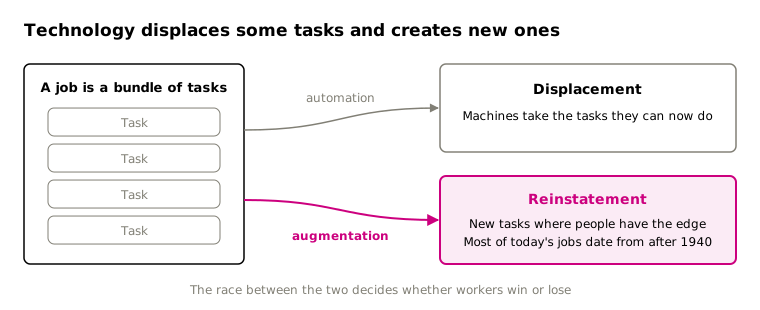
The most useful idea I've found comes from economists Daron Acemoglu and Pascual Restrepo. They say we should stop thinking about whole jobs and look at the individual tasks inside them. When a new technology arrives, two things happen at once. Machines take over some of the tasks people used to do, which they call displacement. At the same time, new tasks appear that people do better than machines, which they call reinstatement. Whether workers come out ahead depends on which of those two forces is stronger.
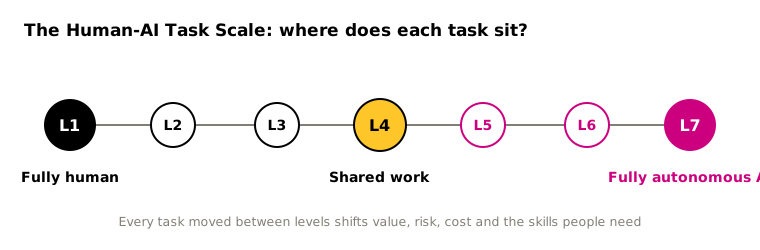
That second part gets ignored in most AI conversations. Jobs don't get automated. Tasks do. Once you see work that way, the real question becomes which tasks move to the machine, which stay human, and which become shared. That's exactly why I built the Human-AI Task Scale.
History gives us a warning and a promise
The warning is that displacement is real. Acemoglu and Restrepo studied the spread of industrial robots across US local labor markets. In areas that added one more robot per thousand workers, the share of adults with a job fell by 0.2 percentage points and wages fell by 0.42%.
The promise is bigger. David Autor and his colleagues found that most of today's US employment is in job specialties that didn't exist in 1940. They also found something every CFO should know. Innovations that augment workers raise demand for labor. Innovations that automate their tasks lower it. And over the last forty years, the automating effect has grown stronger while the augmenting effect hasn't.
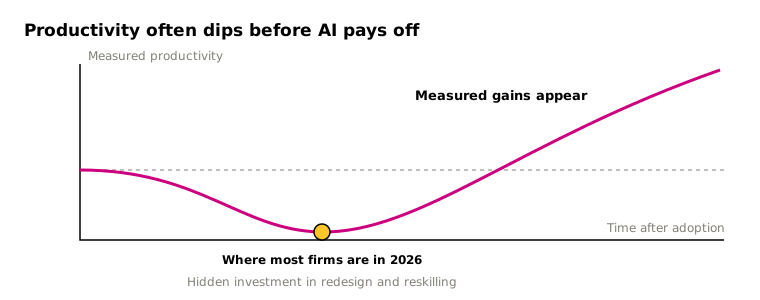
There's one more lesson from history, and it's about patience. Erik Brynjolfsson, Daniel Rock and Chad Syverson describe a Productivity J-Curve. Big technologies like AI need heavy investment in redesign and reskilling before the gains show up. Most of that investment never appears on a balance sheet, so productivity can look flat for a while.
AI isn't just another robot
Two studies convinced me this wave behaves differently.
The first looked at 5,179 customer support agents. With an AI assistant, productivity rose 14% on average and 34% for novice and low-skilled workers. Experts barely moved. Customer sentiment and employee retention improved too. Earlier technology favored the skilled. This one gives the biggest boost to people still learning the job, which tells me AI is working as performance support.
The second was the Harvard and BCG study of 758 consultants. On tasks within AI's capability, consultants using it completed 12.2% more tasks, 25.1% faster, with more than 40% higher quality. On a task outside that frontier, they were 19 percentage points less likely to get the right answer. The harder problem is that people often couldn't tell which kind of task they were working on.
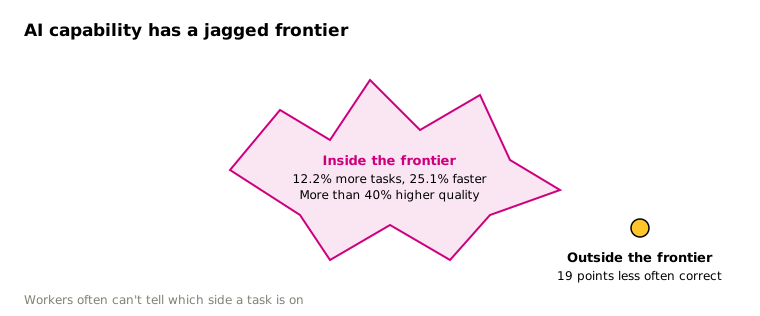
So the decision in front of leaders isn't whether to use AI. It's which tasks to hand over and how much oversight to keep.
What the 2026 numbers say
Start with adoption. Half of US employees now use AI at least a few times a year, according to Gallup's Q1 2026 survey, and 13% use it every day. Yet only about one in ten people in AI-adopting organizations strongly agree it has changed how work actually gets done. RSM sees the same gap from the leadership side. Of the 1,030 mid-market leaders it surveyed, 86% had integrated AI, but just 36% had it fully embedded in core processes. To me, that's what the bottom of the J-Curve looks like.
When people do use it, the payoff is real, if modest. Generative AI users told the St. Louis Fed they saved 5.4% of their work hours, which works out to roughly a 1.1% productivity lift across the whole workforce. Census Bureau data paints a similar picture, with 31% of recent AI users saving one to two hours a week, while 4% said AI actually cost them time.
What surprised me most is where that impact comes from. In Microsoft's 2026 Work Trend Index, culture, manager support and talent practices accounted for more than twice the reported AI impact of individual factors, 67% versus 32%. Whether AI pays off depends less on the person using it than on the organization around them, which makes this as much an HR and L&D finding as a technology one.
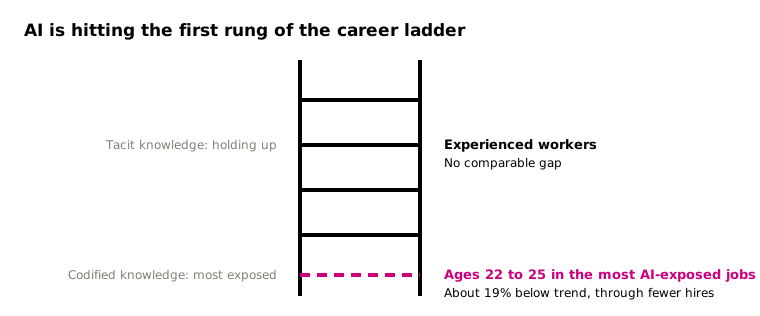
The one study that worries me most comes from Stanford. Employment of 22 to 25 year olds in the most AI-exposed occupations is now about 19% below where it would otherwise be, up from 15% a year earlier. Experienced workers show no comparable gap. The drop is coming through fewer hires, not layoffs. It's concentrated where AI automates tasks and in roles built on codified, by-the-book knowledge. Where AI complements people, employment is flat or rising. The authors are careful to say these are patterns, not proof of cause, and they don't see widespread displacement yet. But it's the same displacement-and-reinstatement story playing out again, and this time it's hitting the first rung of the career ladder.
How I price the shift
The classic automation question is simple: is the machine cheaper than the worker? That works for a robot welder. It breaks down when a person and an AI are drafting a credit memo together. It prices a single task instead of a move between levels of collaboration, and it leaves out the cost of supervising the AI.
I use two tools to close that gap. The first, NET, asks whether a given human-AI setup is worth it.
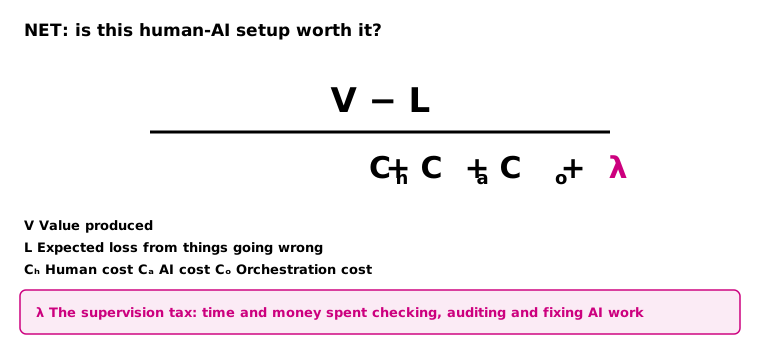
V is the value produced and L is the expected loss from things going wrong. Below the line are human cost, AI cost, orchestration cost and λ, which I call the supervision tax. It's the time and money spent checking, auditing and fixing AI work. The jagged frontier shows up in L. The supervision shows up in λ.
The second, ΔNPV, asks a bigger question: is changing how a piece of work is shared between people and AI worth it over time? At its simplest, it weighs the value that change creates against the risk and cost of making it, and recognizes that the value doesn't all arrive on day one.
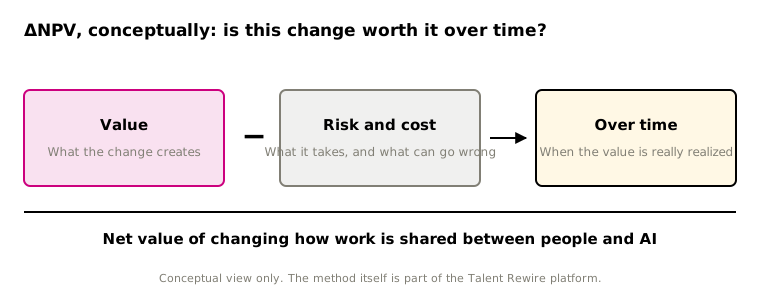
The research behind this post points straight at why all three matter. Value is real: task-level gains of 14% to 25%, and new work that historically outgrows the work it replaces. Risk and cost are real too: a 19-point accuracy drop outside AI's frontier and the supervision it takes to catch it. And time matters, because the J-Curve says the payoff lags the investment.
If you're in finance, this is the honest way to build the business case. If you run operations, it puts supervision on the budget where it belongs. And if you're in HR or L&D, it's where reskilling and new roles finally show up in the numbers.
Where I think this goes
These are my reads on the patterns, not forecasts.
We have to rebuild the apprenticeship. People used to learn a profession by doing the routine work that AI now handles. If entry-level hiring keeps shrinking, the pipeline to tomorrow's experts dries up. The tacit knowledge experienced people hold still matters, but newcomers need a new way to earn it.
We can't wait for new work to show up on its own. Historically, it took decades. Organizations that deliberately modify or create new roles will get there much sooner. One I'm especially excited about is the Human-Machine Performance Analyst, or HMPA. An HMPA breaks a workflow into its individual tasks and decides which ones people should keep, which AI should take on and which should be shared. Then they track whether each of those shifts actually pays off. The role blends performance consulting, data analytics and strong AI fluency, which makes it a natural next step for both business analysts and L&D professionals.
Augmentation is the safer bet, because it's how reinstatement happens. When AI takes on part of a task and people move into new, higher-value work around it, demand for people grows. The historical research and the 2026 data point the same way. Autor found that augmenting innovations raise demand for labor, and Stanford found that where AI complements workers, employment is flat or rising. Automate a task without designing the new work around it, and you get the displacement without the reinstatement.
And budget for supervision. I expect the supervision tax to grow before verification skills and tools catch up.
What I'd ask of each leader
CFOs, ask for business cases that price the move between levels of human-AI collaboration, include the supervision tax, and treat transition spending as an investment.
COOs, map workflows task by task and decide the human-AI level for each step before you automate anything.
CHROs, protect and redesign entry-level roles, and reward people for redesigning work, not just for using the tools.
L&D leaders, build support into the workflow at the moment of need, and teach verification and judgment alongside prompting.
We've priced machines before. Now we have to price AI partners, and that means being honest about the risk, the supervision and the people involved. I'd love to hear where your organization sits on the J-Curve right now.
Sources
Acemoglu, D. and Restrepo, P. (2020). Robots and Jobs: Evidence from US Labor Markets. Journal of Political Economy, 128(6).
Acemoglu, D. and Restrepo, P. (2019). Automation and New Tasks. Journal of Economic Perspectives, 33(2), 3–30.
Autor, D., Chin, C., Salomons, A. and Seegmiller, B. (2024). New Frontiers: The Origins and Content of New Work, 1940–2018. Quarterly Journal of Economics, 139(3).
Brynjolfsson, E., Rock, D. and Syverson, C. (2021). The Productivity J-Curve. AEJ: Macroeconomics, 13(1).
Brynjolfsson, E., Li, D. and Raymond, L. (2025). Generative AI at Work. Quarterly Journal of Economics, 140(2).
Dell'Acqua, F. et al. Navigating the Jagged Technological Frontier. Organization Science.
Brynjolfsson, E., Chandar, B. and Chen, R. (2026). Canaries in the Coal Mine? (August 2026 revision). Stanford Digital Economy Lab.
Gallup (2026). Rising AI Adoption Spurs Workforce Changes.
RSM (2026). Middle Market AI Survey 2026.
Federal Reserve Bank of St. Louis (2025). The Impact of Generative AI on Work Productivity.
US Census Bureau (2026). Does Using Artificial Intelligence Save Time at Work?
Microsoft (2026). 2026 Work Trend Index.
Frey, C. B. and Osborne, M. A. (2013). The Future of Employment.