The Hours Don't Disappear
When AI takes tasks off a workflow, the time it frees up must go somewhere. Most companies see only two places to put it, and both end with people leaving.
In February 2026, JPMorgan’s CEO Jamie Dimon said the line that made the headlines: “We have displaced people from AI.”
Then he said the part that rarely gets quoted: “And we offer them other jobs.”
JPMorgan finished 2025 with 318,512 employees, almost exactly where it started. Underneath that flat number, operations roles fell about 4 percent, support fell about 2 percent, and client-facing roles rose about 4 percent. The bank did not shrink. It rearranged itself around thousands of people who were moved into new roles.
In corporate talk, what happened to those people is called “freed capacity”. It’s a somewhat soulless phrase for something specific: hours that used to be full, attached to a person whose tasks AI completes effectively. I’ll keep using that phrase, because executives need a term they can plan around. But we should agree on what it means before we spend it.
And it does get spent. Almost nobody has a system for deciding how.
Pieces of jobs change before whole jobs do
Kyndryl's former Chief Human Resources Officer, Maryjo Charbonnier, and current CHRO, Mark Paulek, put it plainly, "AI automates tasks and processes first, not entire jobs right away."
A role is not a unit of work. It is a bundle of tasks that happened to be easy to hand to one person. When AI absorbs three of eleven tasks, the role survives as a different bundle, with hours left over.
Kyndryl built its AIR framework (Anticipate, Integrate, Reskill, and Redeploy) on that reality: anticipate how the work, the job descriptions, and the training will change; connect what employees can do to what clients are buying; then train people and move them. Its Bridge program shifted data analysis from manual methods to AI. When some employees no longer fit the rebuild process, Kyndryl gave them new knowledge and skills and placed them elsewhere in the organization.
Reskilling is not what makes this worth studying. Everyone announces reskilling. You can see this in the marketplace with AI enablement. Kyndryl answered the question most programs never do: reskill them for what?
The question nobody asks before implementing training
Adults do not learn on faith. Fifty years of research on how adults acquire skill converges on an unglamorous finding: they commit when they can see the problem the skill solves and the place they will use it, and they disengage when they cannot. Malcolm Knowles called it readiness. Anyone who has watched a mandatory module get clicked through at double speed has seen what its absence looks like.
This is why generic AI-literacy programs return so little. They ask people to acquire a capability with no named destination, promising that a use will turn up. Kyndryl tied its training to client demand it could point at.
Reskilling without a destination is not development. It’s just a budget line with good intentions.
Five places the hours can go
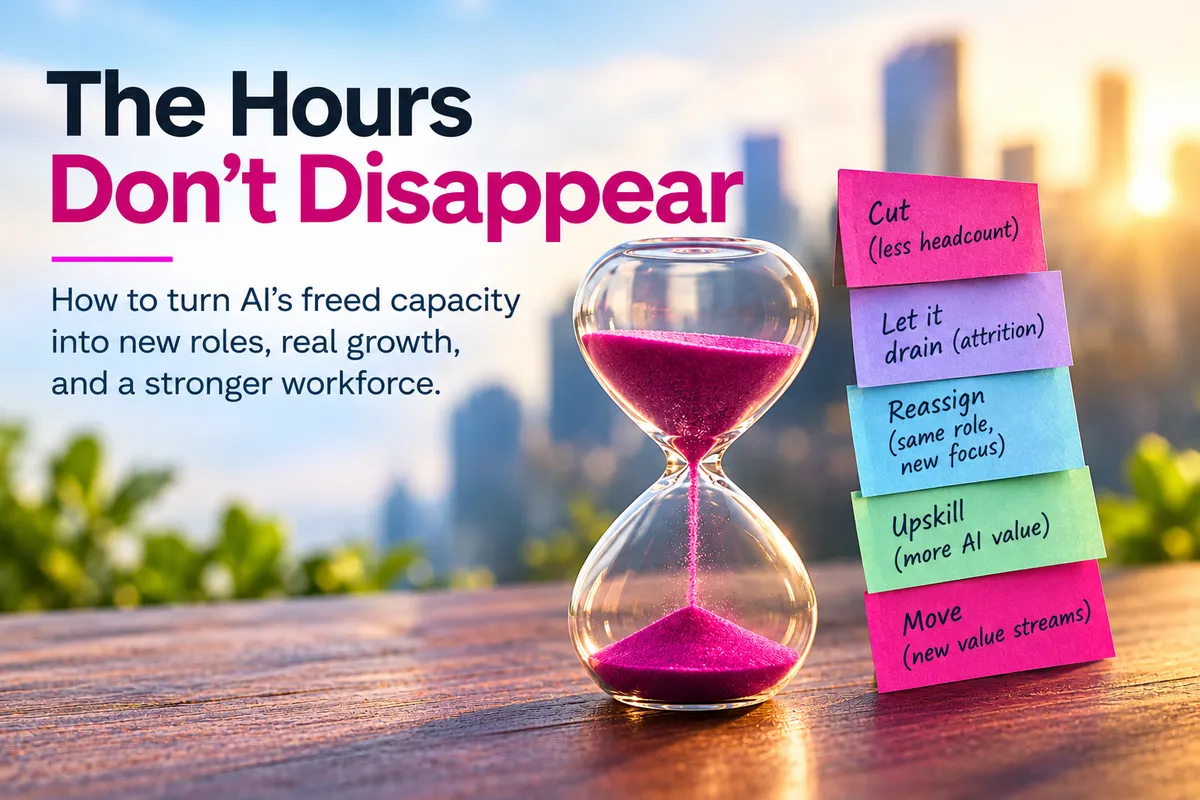
Once AI lifts tasks off a workflow, the released hours have a few destinations. You can cut them, along with the headcount. You can let them drain away through attrition, declining to backfill humans with tacit knowledge, until the company is quietly smaller and less capable. You can reassign them inside the role, so the person stays and the shape of their week changes. You can upskill associates on AI so capacity shifts to improving AI’s outputs. Or you can move the person into a new value stream where demand is growing.
Most companies cut or wait for attrition. Not out of preference, but out of blindness. Those are the only two options that require you to see nothing. The other two require you to know, at the task level, what your people do and what the business will need them to do next. Very few companies can produce that on request.
IBM shows these non-cost-out destinations working. Developers who once spent 80 to 90 percent of their time writing code now spend more of it debugging what the model wrote, configuring solutions for customers, and building things that did not exist. In IBM’s HR department, the AskHR assistant absorbed the routine questions early-career staff used to answer; those employees moved to service recovery, to the qualitative feedback a bot cannot hear, and to improving the bot itself. Nobody changed titles. Nobody transferred. The time inside the job shifted from answering questions to using discernment to verify AI's quality floor.
What it looks like when someone moves
Salesforce retained and retrained as well. After Agentforce began fielding front-line support conversations (2.6 million of them, resolving 63 percent), the company moved hundreds of support engineers into forward-deployed engineering, AI-agent evaluation, customer adoption, renewals, success architecture, and AI conversation design.
Ankita Piludaria was one of them. She supported Marketing Cloud; she moved into renewals. She was uncomfortable at first, which is the detail most case studies leave out. Her working vocabulary had to change from APIs and SQL queries to pricing and revenue targets. What carried over was what her job title never captured: she could hear a technical problem inside a commercial conversation. “If they have any technical issues,” she said, “I know where to transfer those cases or how to resolve those issues, so they stay with us.”
Kristen Chuck spent eight years in technical support and used Career Connect, Salesforce's internal talent marketplace, to move herself into a success architect role, earning an Agile certification on the way. Sarah Thakkar, a developer support engineer for seven years, read her own move as confirmation: “Leadership saw the value that we brought to support roles and how our skills could be used in other ways.”
Her position became less necessary, and she became more valuable, at the same moment, at the same company. Salesforce could see that only because it stopped reading her as a job title and started reading what she held: product knowledge, diagnostic reasoning, customer language, an instinct for why accounts leave.
Commonwealth Bank of Australia is running the same method at scale. Its three-year, roughly A$90 million Future Workforce Program breaks roles into component tasks, names the skills each task demands, marks where AI touches them, and points people toward roles with rising demand: current role, component tasks, transferable skills, roles in demand, in that order. Then it goes further than a job board. A four-week Career Transition Placement puts an employee inside a possible destination role before anyone commits, an audition with the reskilling attached.
The objection
By now a reasonable executive is thinking: this is layoffs with a change-management budget stapled on. Nicer vocabulary, same arithmetic.
Task analysis doesn't guarantee anyone gets redeployed. It only makes redeployment possible. Business conditions and leadership conviction decide the rest. What the analysis does guarantee is that you have a choice to make. Without it you have no choice at all. You have a default, and the default is the first two destinations: cut headcount or wait for attrition.
The survey data agrees. Among 321 service and support leaders Gartner surveyed in April 2026, 85 percent were expanding what human agents do and 75 percent were moving agents into new roles, while 63 percent were thinning the front line through attrition and 31 percent had run or planned AI-related layoffs through Q1 2027. Redesign is more common than mass elimination, and it lives right alongside it.
You cannot move capacity you cannot see
Every company in this post ran the same playbook. Map the workflow. Break it into tasks and steps. Decide what the machine does and what the human does. Price the change before committing. Work out how many hours it releases. Choose deliberately where they go. Then build the people for the work that is waiting.
Skip the front half, and cutting or waiting stop being decisions. They become what's left when you never generated anything else to choose between.
Dimon's sentence is worth reading once more, both halves this time: we have displaced people from AI, and we offer them other jobs. The second clause is an operating capability. Ankita Piludaria, learning the vocabulary of renewals after years of reading stack traces, is what it looks like when a company has built one.
Build yours before you need it.
Sources
JPMorgan Chase 2026 Company Update; HR Grapevine (Feb. 25, 2026); CNBC (Feb. 24, 2026)
SHRM, “The CHRO & CIO: Reinventing Work for the AI Era” (Oct. 20, 2025) — Kyndryl
Salesforce, “How Salesforce Is Reshaping Its Workforce in the Age of AI”; “A Workforce Evolution for the Agentic Enterprise” (2026) — Piludaria, Chuck, and Thakkar quotes
Commonwealth Bank, “Future Workforce: CBA Launches New Skills and Careers Program” (Feb. 2026)
HR Executive, “IBM CHRO: Focus on AI Productivity at Your Own Risk”
Gartner, “85% of Service Leaders Are Expanding Human-Agent Responsibilities” (Apr. 2026)
Knowles, M., The Adult Learner — readiness and orientation to learning