
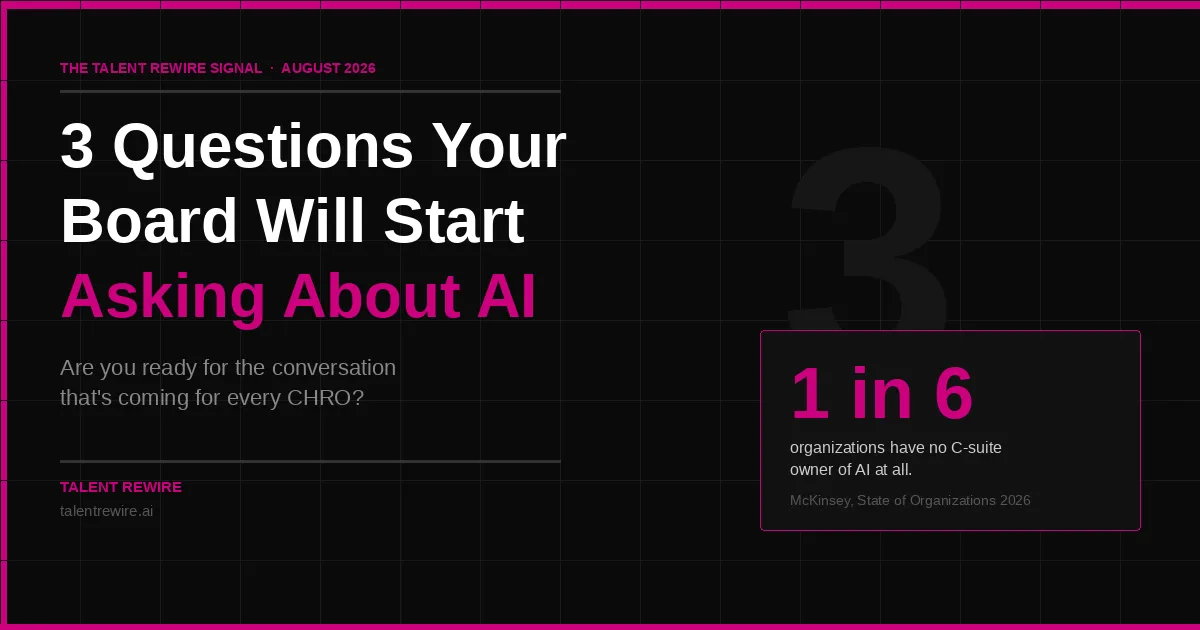
3 Questions Your Board Will Start Asking About AI (Are You Ready?)
3 Questions Your Board Will Start Asking About AI (Are You Ready?)
There’s a conversation happening in boardrooms about AI strategy that includes slides about tools, investments, productivity gains but too rarely answers or even asks the question: What are we actually doing with our workforce?
You know the pattern. A board member asks something like “how do we know our people are ready for this?” and the room gets quiet in a way that’s uncomfortable for everyone, because nobody has built the infrastructure to truly answer it beyond perhaps an organizational enablement or training plan.
The conversation must shift, and in the organizations we speak to who are integrating people into AI strategy, specific questions are being asked and answered.
Question 1: Which functions and roles are most exposed to AI disruption and on what timeline?
Most organizations have a vague sense that “AI will change everything” without the specificity to act on it. Boards are pushing past the vague. They want to know: where specifically, and when specifically?
A real answer requires task-level outcome-based analysis. Why? Because within a single role, some tasks will be fully automated, some will be augmented, and some won’t change much at all. A function that looks “low risk” at the role level might have 40% of its tasks sitting squarely in the automation zone when you actually look at the work.
Most organizations have never done this analysis. They’re making workforce decisions based on job titles and headcount, which is a bit like navigating from an outdated printed map.
Question 2: Do our people have the skills to work effectively alongside AI?
This is the question that separates organizations doing L&D from organizations doing workforce transformation.
In some organizations, the answer sounds like this: “We’ve rolled out AI literacy training and piloted a few tools.” That’s real work. But it doesn’t fully answer the question.
A better answer sounds like this: “We’ve mapped the skills our people have against the skills the work now requires, we know where the gaps are concentrated, and we have a targeted plan to close them.”
Most organizations are closer to the first answer than the second. The reason is a lack of data. You can’t close a gap you haven’t measured. And most organizations have not done the diagnostic work to understand what their workforce is actually capable of versus what AI-augmented work will actually require.
This is one of the central arguments in our forthcoming book, Rewiring Your Organization for AI: Human-First Leadership for the Future of Work (ATD Press, September 2026): the organizations that will lead understand their people well enough to make the transition deliberate. Pre-order it here: Amazon
Question 3: Who owns this?
McKinsey’s State of Organizations 2026 report found that one in six organizations has no clear C-suite owner of AI at all.
It’s not just “who owns AI strategy?” Most organizations have assigned it to the CTO, the Chief AI Officer, or the newly formed AI committee. The real question is: who owns the workforce side of AI readiness? Who is accountable for ensuring your people can actually do the work that AI is reshaping?
In too many organizations, the answer is: nobody, specifically.
The CHRO is responsible for the workforce but often gets handed an AI strategy built without them and asked to “handle the people side.” The CTO owns the tools but not the talent. The Chief AI Officer is managing the roadmap but not the redeployment. Everyone is adjacent to the workforce transformation problem. Nobody owns it.
If you can’t name a specific person with a mandate and a budget to match, you have a gap that will show up at the worst possible time.
Why most CHROs can’t answer these questions yet
I want to be clear: the reason most HR leaders can’t answer these questions fluently isn’t a leadership failure; it’s an infrastructure miss.
Answering Question 1 requires task-level role analysis at scale. Answering Question 2 requires skills data that most organizations don’t have in actionable form. Answering Question 3 requires a governance conversation most organizations haven’t had yet.
These are problems of organizational design and information which are solvable with the right methodology and the right data.
The organizations getting ahead started with an honest assessment of where they were, built the infrastructure to answer these questions, and moved from there.
If you can walk into your next board conversation with clear, confident answers to all three questions you will be ahead of the majority of your peers. That’s a significant strategic advantage.
How we can help
The fastest path to answering all three questions is a structured diagnostic that maps task-level AI exposure across functions, surfaces skills gap data at the role level, and produces a prioritized roadmap that someone can actually own.
That’s exactly what we built at Talent Rewire. If you’re preparing for a board conversation, a strategic planning cycle, or just want to stop answering these questions with “we’re working on it” let's talk.
P.S. Know a CHRO or VP of HR navigating this right now? Forward this their way; it might be exactly what they need.
Source: McKinsey & Company, The State of Organizations 2026, survey of 10,000+ senior executives across 15 countries and 16 industries.