The AI Readiness Gap Is Bigger Than You Think
The AI Readiness Gap Is Bigger Than You Think
New research puts a number on how far behind most organizations actually are.
Here's a question I’ve been thinking about a lot: if 88% of organizations are deploying AI, why are so few of them seeing results?
This is the central finding of McKinsey's newly released State of Organizations 2026 report, based on a survey of more than 10,000 senior executives across 15 countries and 16 industries. The numbers are worse than most leaders assume and they are worth doing a deeper dive on.
The headline numbers
Let's start with the gap itself. According to McKinsey's data:
88% of organizations are actively deploying or experimenting with AI. Adoption is no longer the differentiator. Nearly everyone is in the pool.
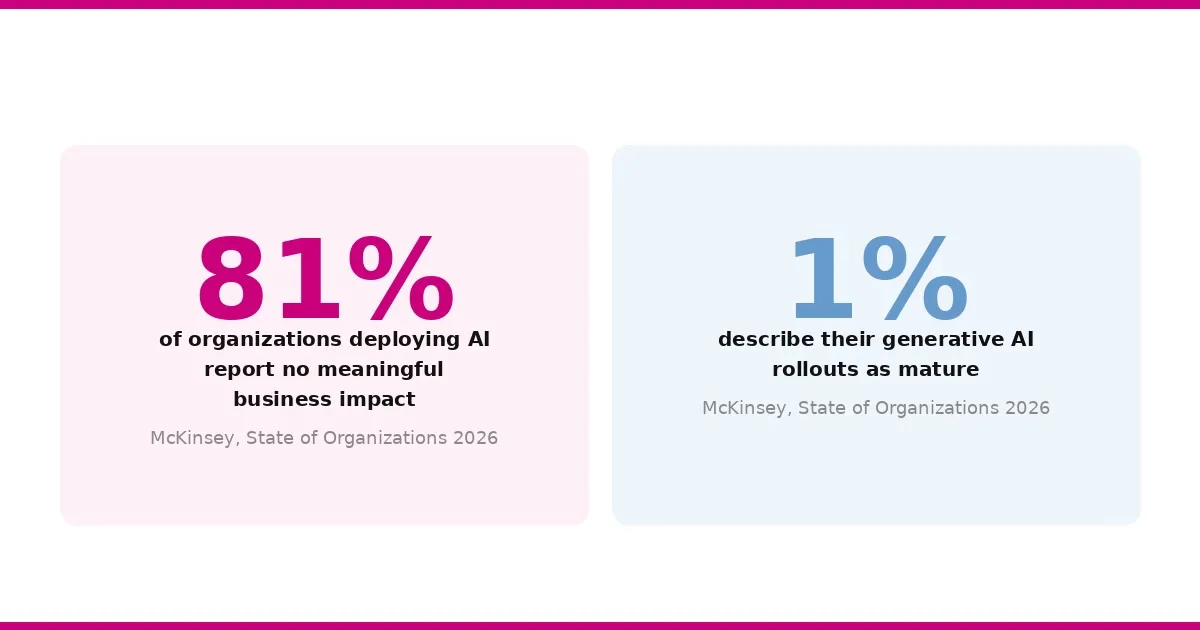
81% report no meaningful bottom-line impact from those investments. Four out of five organizations spending real money on AI cannot point to real results. This is beyond scary, given the previous number that 88% of organizations are investing in AI.
Only 1% of C-suite respondents describe their generative AI rollouts as mature. One percent.
86% of leaders say their organization was not prepared to integrate AI into day-to-day operations. So for all the technology investment and AI enablement, very few organizations have been ready for any meaningful change to how work will get done.
One in six organizations has no clear C-suite owner of AI at all. The most consequential technology shift in a generation, and nobody's name is on it.
If you've been telling yourself your organization is a little behind but basically on track, this data suggests a harder truth: almost everyone believes that, and almost everyone is wrong.
This is not a technology problem
The organizations in the 81% that didn’t see an impact didn't buy bad tools. They bought the same tools as everyone else. What separates the 1% from the rest is organizational readiness.
McKinsey's own framing makes this explicit: most companies are running AI in isolated pilots and individual productivity use cases rather than redesigning workflows, roles, and decision rights around what AI can actually do. The result is a lot of activity and very little transformation. Individual employees get a bit faster. The enterprise stays exactly the same.
The report also surfaces what McKinsey calls an optimism gap. Just over half of leaders expect positive outcomes from their current transformation efforts, yet 72% describe their organizations as not fully ready to execute on the changes ahead. Leaders can see where they need to go but don't believe their organizations can get there.
What the report uncovers is a widespread readiness problem. And readiness lives in your people, your workflows, your governance, and your leadership alignment, not in your tech stack.
Why the gap keeps growing
The uncomfortable dynamic underneath all of this: the readiness gap compounds. Organizations that redesigned workflows around AI early are now layering agentic systems on top of that foundation. Organizations still stuck in pilot mode are falling further behind every quarter, because the leaders aren't just ahead on tools. They're ahead on organizational muscle: the diagnostic clarity to know where AI creates value, the role redesign to capture it, and the workforce capability to sustain it.
You cannot close that kind of gap by buying another license but by understanding, with precision, where your organization actually stands. Which functions are ready. Which workflows are worth redesigning first. Where your skills gaps are concentrated. Who owns what.
Most organizations have never done that diagnostic work. That's why 86% of leaders describe themselves as unprepared. They don't have the data to turn it into a plan.
The good news buried in the bad news
This report is actually quietly encouraging if you're willing to act on it. When 81% of your competitors are getting no return on their AI investments, the bar for differentiation is readiness. The organizations pulling ahead aren't smarter but started with an honest assessment of where they were, and they built from there.
The gap is bigger than you think. It's also more closable than you fear. But only if you start with a clear-eyed diagnosis instead of another pilot.
How to get started
Organizations that want to shift from the “no impact” 81% to the 19% showing business impact need to focus on workflow analysis, business goals and outcomes metrics, human-AI work redesign, and cost analysis in the context of people, technology, and governance. Skills data becomes more important than ever in understanding how ready your workforce is to take on new responsibilities and collaborate with AI. It’s also critical to identify the biggest potential areas for AI impact, and whether your goal is augmentation of existing workflows with AI-powered but human-led tools, or automation of portions of existing workflows with agents, or completely transforming how work will be allocated between human and AI labor.
Organizations that can answer these questions with confidence will not only have a transformation roadmap they can execute with conviction, they will also have business impact targets they can measure against to determine whether investments are paying off.
P.S. We help organizations close this gap in weeks, not years. Curious what that looks like for your team? Book 30 minutes with us.
Source: McKinsey & Company, The State of Organizations 2026, survey of 10,000+ senior executives across 15 countries and 16 industries.