Who Decides What Work AI Does?
Why We're Re-Announcing Talent Rewire
Something has been shifting in my conversations with leaders over the past several months. Organizations are starting to realize that work design, and specifically deciding whether a task should be done by a person or by AI, is going to become part of the job of line of business leaders. In addition to managing people and business outcomes, those leaders will be making decisions about what work people do and what work AI does. And they'll keep making those decisions, over and over, as the technology and the business change around them.
That's a lot to ask of leaders who, in most organizations, don't have a clear, documented view of how work actually gets done.
The questions behind every human vs. AI decision
To make good calls about AI, leaders need to understand work at a level of detail most of us have never needed before. Which tasks lead to optimal outcomes? Where are decisions being made, and by whom? What does it cost to have a person do this work, and what does it cost to have AI do it? What is the cost of overseeing and managing that AI once it's in place? (That last one is the line item I see missing from almost every business case.) And then there's the hardest question of all, which is how you orchestrate all of these pieces intentionally rather than letting them pile up one tool and one pilot at a time.
How our thinking has evolved
When we started Talent Rewire, we were dedicated to providing the analysis leaders need to make informed AI transformation trade-off decisions. That is still at the heart of what we do. But as we worked alongside organizations, it became clear that a point-in-time analysis, however good, only gets you so far. The work keeps moving.
So the latest iteration of our product has grown into something more durable: a record of responsibility, transparency in accountability, and a true system that documents how work is done for any team, with any mix of AI integration. When a task moves from a person to an agent, or from an agent back to a person with new oversight attached, that change is captured, along with who is accountable for the outcome.
What organizations need
Based on what we've seen, organizations need four things to do this work well.
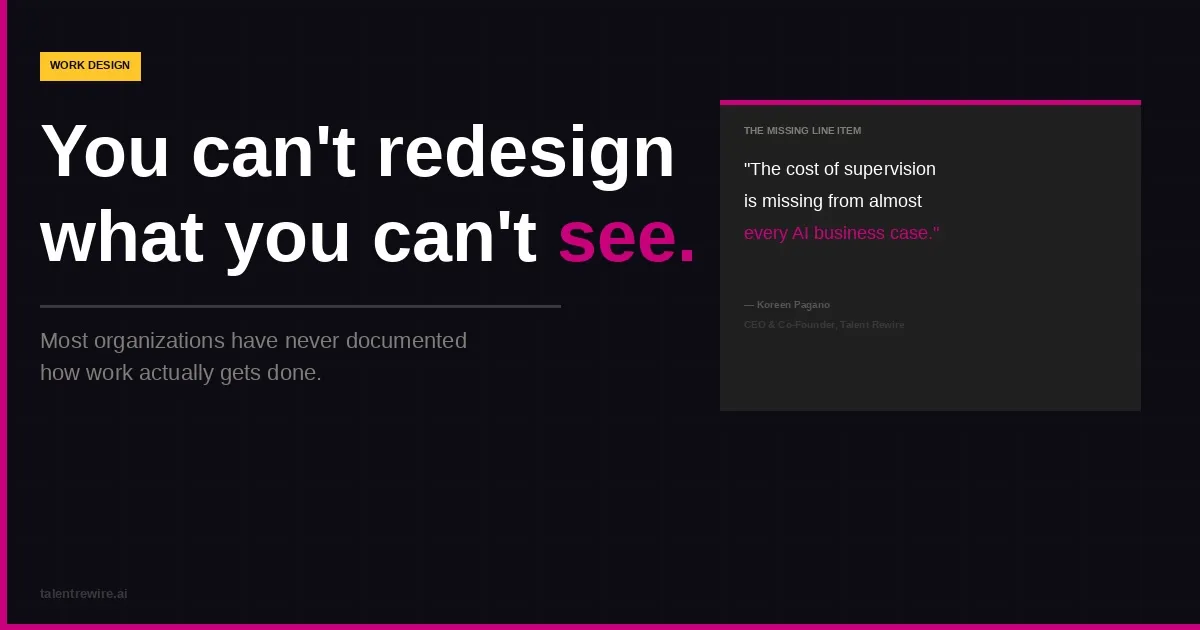
Visibility into how work is getting done today. You can't redesign what you can't see, which is why we start with workflow validation. Most teams carry a fair amount of hidden work that never shows up in a job description or a process map.
A system for assessing which use cases are best transformed by AI. Not every task that can be automated should be, and that assessment has to account for complexity and risk, not just volume.
A way to model the potential impacts of AI. That means cost, the new tasks and supervision AI will require, and the capacity it frees up for people to do something more valuable.
A trusted record of how work is evolving. With that record, the organization can form an informed view of what skills its people need, how roles and responsibilities are changing, and where AI can best help next.
Why we're re-announcing now
There are two reasons. The first is simple: we've built the capabilities to support organizations that need answers to these challenges, which, as best we can tell, is all organizations.
The second is something we're seeing in the market. Organizations are hiring people into newly created roles meant to support ongoing work design and orchestration. That might be the clearest signal yet that this is becoming a permanent function rather than a one-time transformation project, and the people stepping into those roles need a system to work from.
We're excited to show you our approach and how it can give you a jumpstart on this important work. If you're a leader taking on these decisions, or you've just hired someone who will, I'd love to talk.